



Four TKC Options for This Season’s Adventure Rides
Fall can be a great time to explore beyond the pavement. In areas where summer heat has eased, cooler days and changing scenery make dirt roads especially inviting. But the surface changes, too: a route that was dusty a few weeks ago may now have mud, ruts, or wet rocks. Match your route and your tires to the conditions, whether you’re heading out for an afternoon or a longer trip.
The new Continental ContiTrailAttack 4 takes a 90% on-road / 10% off-road approach, so occasional unpaved detours remain part of the picture. If you’re looking for more capability away from pavement, though, the TKC family deserves a closer look. From the TKC 70 through the TKC 70 Rocks, TKC 80, and TKC 80², the choice depends on how much dirt you ride and, more importantly, what that dirt is like.
Continental TKC 70: When Pavement Still Comes First

If you commute on your adventure bike, enjoy winding mountain roads, and include easy to moderately challenging dirt roads in your trips, consider the Continental TKC 70. Its 70% on-road / 30% off-road focus opens up more route options while keeping the paved miles before and after each dirt section firmly in mind.
Compared with the TKC 80, its more closely spaced tread pattern provides more continuous contact with pavement. The block layout is designed to balance stability, agile handling, and a quiet ride with the ability to tackle gravel and dirt. It also features RainGrip for wet grip and MultiGrip, which uses a controlled curing process to create different levels of hardness within a single compound: greater wear resistance in the center and more flexibility at the shoulders.
Choose the TKC 70 if dirt is part of your weekend plans but technical terrain isn’t the main goal of every ride. For hard-packed roads mixed with plenty of pavement, it makes more sense than choosing an aggressive knobby just for its looks. If deep mud or very loose surfaces are a regular part of your route, consider a more off-road-focused option.
Related


Continental TKC 70 Rocks: More Rear-Wheel Traction in the Dirt

There’s an important distinction: the TKC 70 Rocks is a rear tire, developed to pair with a TKC 70 front. It does away with the standard TKC 70 rear’s continuous center strip and uses a revised block arrangement to increase off-road traction. It features MultiGrip, RainGrip, and ZeroDegree technologies; ZeroDegree uses a zero-degree steel belt to support stability.
It’s an option for riders who still need to cover highway miles but want more rear-wheel grip on gravel and loose dirt. Remember, though, that fitting a Rocks rear doesn’t change what your front tire can do. If tougher terrain is becoming a regular part of your rides, evaluate the whole setup rather than focusing only on drive traction.
Related

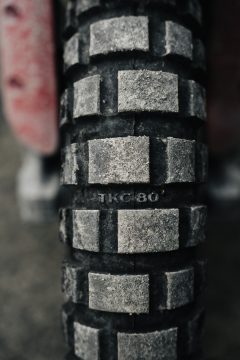
Continental TKC 80: The Classic for Dirt-Focused Adventures

Its open, widely spaced tread blocks help provide mechanical grip on loose surfaces and allow the tread to shed material. That matters in loose dirt, sand, and mud, where the tire needs to find purchase and clear the spaces between its blocks rather than simply maximize rubber contact as it would on pavement.
Consider it if you want an established knobby design for routes with a substantial off-road component. Choosing it over the TKC 70 family is about matching the terrain you plan to ride, not declaring one tire better in every situation.
Related

Continental TKC 80²: The Next Generation for Modern ADV Bikes

The tread features redesigned blocks, additional biting edges, and stepped shoulder blocks to support traction and self-cleaning. Each end has a specific job: the front pattern is designed to improve braking grip on loose terrain, while the rear focuses on traction under acceleration. The optimized carcass contributes to stability and damping, along with resistance to damage and punctures. That does not make it puncture-proof.
Its new compound, featuring RainGrip technology, improves cold- and wet-weather grip compared with the classic TKC 80, as well as wear resistance. The TKC 80² is worth considering if you want the latest development in the family for demanding off-road routes combined with paved travel. If you’re deciding between generations, look at these changes, the sizes approved for your bike, and the conditions you expect to encounter.
Related

How to Choose: Think About Terrain, Not Just Percentages
On-road/off-road ratios are a useful guide, not a certification or a performance guarantee. You don’t need a calculator to divide up your mileage, either: a hundred miles of hard-packed dirt may ask less of a tire than a short stretch of mud. Before choosing, work through these questions:
- What conditions will you encounter this season? Don’t choose tires based only on what a road looked like in summer. Check forecasts and current route conditions: rain can transform familiar terrain. Knobbies and wet-grip compounds don’t remove the limitations imposed by mud, wet leaves, or cold weather.
- What bike are you riding, and how much are you carrying? Weight, suspension, wheels, luggage, and a passenger all affect the setup. Follow the tire sizes, load and speed ratings, and fitment requirements specified for your motorcycle. Check tube-type or tubeless compatibility, too.
- How much off-road experience do you have? Suitable tires help, but they don’t replace technique. If you’re starting out, choose manageable routes and build your skills gradually. You don’t need a difficult trail to enjoy an adventure bike.
- Are your tires ready to ride? Inspect tread condition, look for damage, and check cold pressures against the manufacturer’s recommendations for your use and load. Don’t copy another bike’s pressures or automatically air down as soon as you reach dirt.

For more help matching tread design to your riding, read our guide to knobby and dual-sport tires for adventure riders. You can also explore the Continental TKC 80²’s design and features for a closer look at the latest generation.
This season, choose tires for the rides you’ll actually take. Stick to roads and trails open to motorized travel, check local restrictions and seasonal closures, and change plans if the terrain exceeds your skills or your bike’s capabilities. Knowing when to take a different route is part of adventure riding, too.