
The grooves in your tires do far more than give them their distinctive look
Take a quick look at any motorcycle tire and one of the first things you’ll notice is its tread pattern. Whether it’s a road tire, an adventure tire, or a track-focused model, every design looks different—and that’s no coincidence.
Those grooves are the result of countless hours of engineering, testing, and refinement. While they certainly contribute to a tire’s appearance, their primary purpose is to deliver the right balance of grip, stability, durability, and safety for the type of riding the tire was designed for.
Related

Every Tire Starts with a Purpose
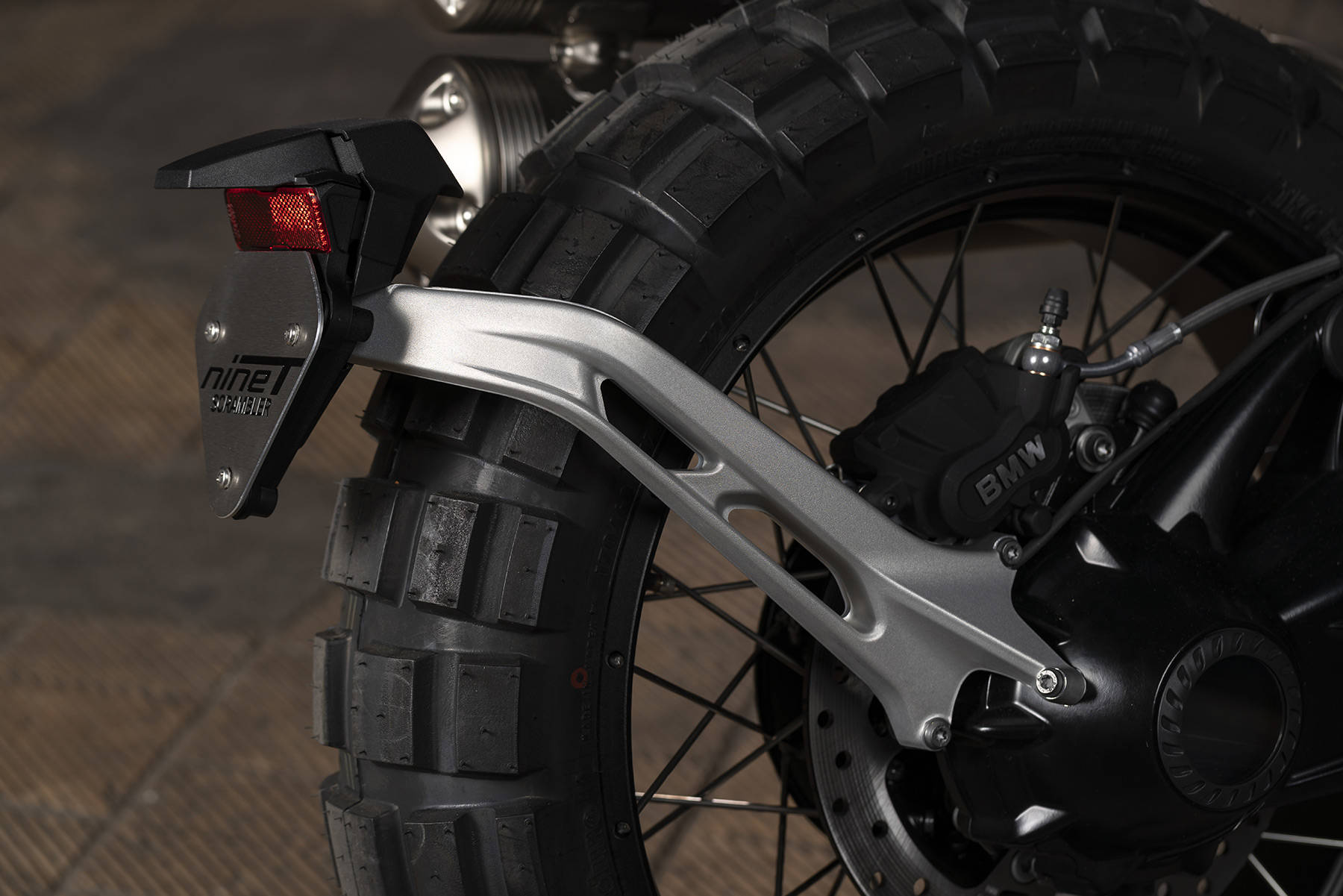 Before a new motorcycle tire reaches the market, engineers define exactly what it is expected to do. A sport-touring tire has very different priorities than a dual-sport tire, and both differ from a tire intended primarily for track use.
Take the Continental TKC 80, for example. Designed for riders who split their time between pavement and loose terrain, it features a robust bias-ply carcass and deep, angular tread blocks that help generate traction on dirt, gravel, and other challenging surfaces.
Every tread pattern is developed around the tire’s intended application, ensuring it performs where riders need it most.
Why Street Tires Need Tread
If maximum grip on perfectly dry pavement were the only goal, a completely smooth tire would be the ideal solution. That’s exactly why racing slicks are used in professional motorsports under controlled conditions.
Real-world roads, however, are rarely perfect. Rain, uneven pavement, dust, and debris all demand a different approach.
On street tires, tread grooves help evacuate water from the contact patch, maintaining effective contact with the road surface and reducing the risk of hydroplaning in wet conditions. Combined with the tire’s compound and construction, they play an important role in delivering consistent grip. On adventure and dual-sport tires, those same grooves also help the tire bite into loose terrain for improved traction.
More Than Suspension: The Tire’s Hidden Job
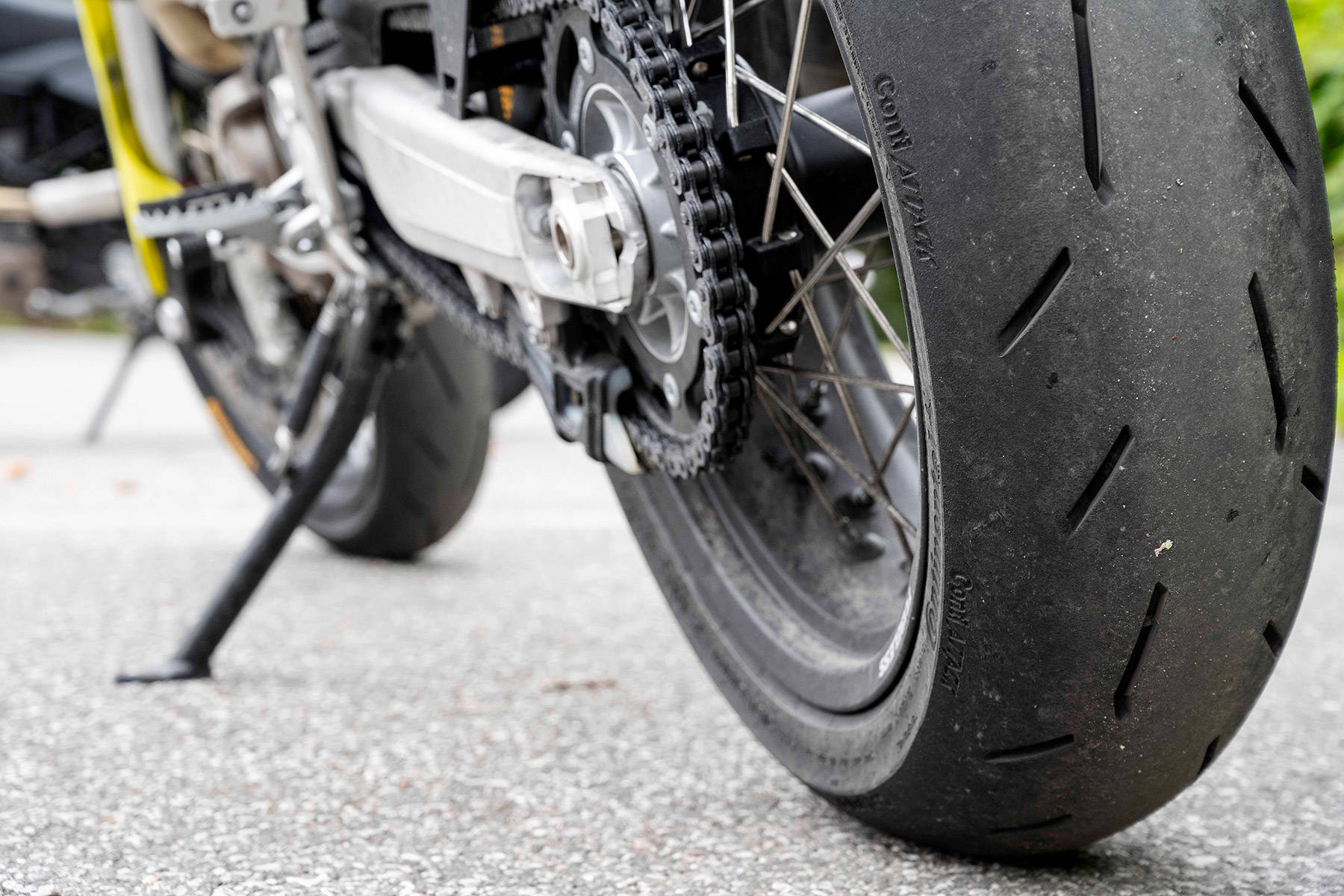 Motorcycle tires don’t simply roll over the road—they actively absorb forces generated while riding.
Every bump, corner, acceleration, and braking input creates loads that the tire itself must manage alongside the suspension. To do that effectively, the tire needs controlled flexibility.
A carefully engineered tread pattern works together with the tire’s carcass to allow controlled flex while maintaining the durability expected from a road tire. Finding that balance is one of the biggest challenges in tire development.
Track-oriented street-legal tires such as the Continental ContiRaceAttack 2 and ContiAttack SM EVO are good examples of this philosophy. Their tread patterns are kept to the minimum required for DOT approval while maximizing the amount of rubber in contact with the road.
Built-In Safety: Tread Wear Indicators
Tread grooves also serve another important purpose: they make it possible to monitor tire wear.
Unlike racing tires, where experienced riders often judge wear through feel and lap times, everyday riders need a much simpler way to know when it’s time for replacement.
That’s where Tread Wear Indicators (TWI) come in. These small raised bars are molded into specific locations within the tread grooves. Once the surrounding tread wears down to the same level as the indicator, the tire has reached its service limit.
In the United States, the legal minimum tread depth for motorcycle tires is 1/32 inch (0.8 mm), and TWI markers are positioned accordingly.
Related

Engineering Meets Design
 Performance always comes first, but appearance also plays an important role.
Unlike many automotive tires, motorcycle tires remain highly visible once mounted on the bike. Their tread pattern becomes part of the motorcycle’s overall look and often contributes to a manufacturer’s visual identity.
That’s why tread design is a collaborative process involving both engineering and design teams. Engineers focus on performance targets, while designers help create a distinctive appearance that riders immediately recognize.
How a Tread Pattern Is Developed
Creating a new tread design is a lengthy process involving multiple departments.
It typically begins with product planners and marketing specialists defining what the new tire needs to achieve and which competitors it will face.
From there, engineers and designers develop multiple concepts using advanced computer simulations, laboratory testing, and extensive real-world validation before selecting the final design.
Once several promising designs have been validated, they are reviewed from both technical and commercial perspectives before the final pattern undergoes comprehensive durability, performance, and quality testing ahead of production.
Function and Style Can Coexist
 One common misconception is that tread patterns are designed primarily for appearance. In reality, every groove and channel exists for a functional reason.
The tread pattern is just one element of the tire’s overall performance, working together with the rubber compound, carcass construction, and tire profile to achieve the desired riding characteristics.
What’s equally important is that engineers don’t evaluate the tread based solely on how it looks while the motorcycle is parked. They study how the pattern deforms under load, at different lean angles, and across a wide range of speeds. The interaction between tread design, carcass construction, and rubber compound ultimately determines how the tire behaves on the road.
The visual design is simply the final expression of a much more complex engineering process.
Designed to Perform—and to Look the Part
A successful motorcycle tire has to do more than catch your eye. It needs to inspire confidence in changing conditions, deliver predictable handling, wear evenly over thousands of miles, and provide the performance riders expect every time they head out.
That’s the philosophy behind Continental motorcycle tires: combining proven engineering with thoughtful design to create products that not only look right on the bike, but also deliver the balance of grip, durability, handling, and safety riders expect every time they ride.
Related