



What Do The Numbers And Letters On My Tires Mean?

In today’s post, we are going to show you the basic and necessary information to know the measure or measures that we have to ask for to get the right tire on our bike, but also to differentiate a little more complex data such as the load index or homologation.
Tire size
Each motorcycle model requires specific tire sizes that are indicated by the manufacturer in its technical data sheet. It is very important to try to stick to the recommendations for safety and to adhere to the regulations of the road. You can see these measurements by looking on the side of the tire, where you will find something like this: 120/70ZR17 or 90/90-21.
Although we are going to focus on some of the most common sizes, we must take into account that there are also other types of sizes such as: 3.00-19, or MT90B16… The first are designations in inches and are still common, although less and less,while the latter can be found on V-Twin motorcycles, such as Harley Davidson or Indian. In this case they are alphabetical designations.
Going back to the example size 120/70ZR17, in this case 3 types of measurements are combined: 120 in millimeters, 70 in percentage and 17 in inches. To understand what each of them means, we must imagine a cut tire as in the following picture:


Now let’s see what is 70 (120/70ZR17). This number designates the height of the tire section, but as a percentage of the width (120mm). This means that the section height will be 70% of 120. In other words: 120 x 70 / 100 = 84mm. And what is the section height for? You may ask… To be able to calculate the total diameter of the tire if necessary or if you want to change the size.
Finally, let’s look at the 17 (120/70ZR17). This measure, denominates the diameter of the rim, which is the part where the tire is fitted. In this case, the measure is designated in inches and first of all, we have to know that 1 inch is 25.4mm. Now we must imagine the whole wheel (the tire and the rim) cut. We would be left with this section.
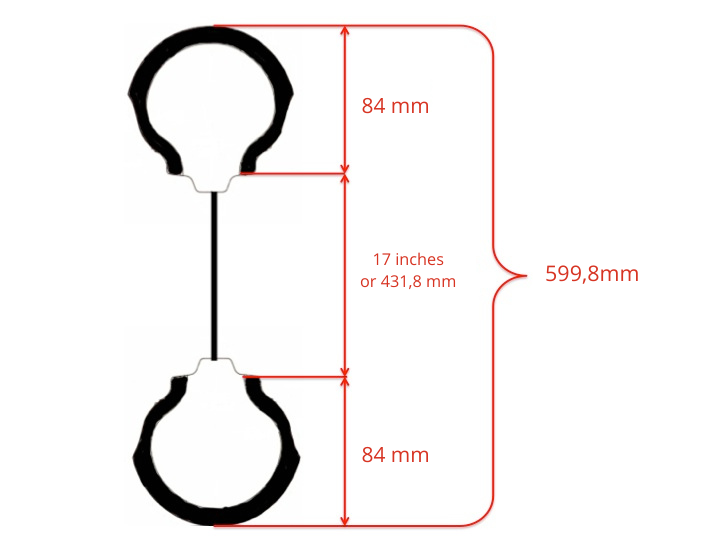
In the image, we can see that corresponds to the measure 17 inches or what would be the same 431.8 millimeters. Anyway and as we have said before, you can always consult the technical data sheet of your motorcycle to see the approved measures and that there is no doubt.
Construction
You may have noticed that we are still missing a piece of information from the previous sizes (120/70ZR17). These letters indicate the type of internal construction of the tire, whether it is radial or diagonal. If it is radial, it is indicated with a letter R or ZR, while if it is diagonal, it is usually not indicated, i.e. it is not indicated at all. If you want to know the difference between these constructions and how they affect the performance of the tire, you can read all about it in the following article.
Related


On the other hand, on Continental tires you will usually find the letters M/C, which indicates that it is a MotorCycle tire. If you find M+S it means that they are tires with a special grip for mud and snow.
Load capacity and speed symbol
In this section we are going to look at the load capacity index and the speed category symbol, i.e. numbers and a letter after the tire size. In the photo below, which we take as an example, we can see that after the size (130/70-12) and the tire type designation (M/C= MotorCycle), we can see 62L, “62” is the load capacity index and “L” is the speed category symbol.

And what does each of them do? In this case, the 62 indicates the load or weight that a tire can support in operating conditions. In this case the tire can hold 265 kg, as long as it does not exceed the specified maximum speed, which is determined by the letter “L” and corresponds to the Speed Category Symbol.
The speed index is always represented by a letter, starting with “A” for low speed tires and going up in alphabetical order. On motorcycles, the easiest to find are M, N or P for off road tires (130, 140 or 150 km/h) and U or V for racing bikes (200 or 240 km/h). The highest letter we can find is Y, which corresponds to 300 km/h.
Other data
If we take a closer look at our tires we will see that there is even more information about them on their sidewall, although with somewhat smaller letters. If we look closely we will see that they also indicate their load capacity (but this time specified in kilograms and pounds), the pressure in Kilopascals (KPA) and Pounds per inch (PSI), their homologation code after the acronym DOT, the date of manufacture or if they are tubeless or not.
